Navigating Affiliate Revenue Models and Their Influence on Progressive Jackpot Participation Criteria Across UK Licensed Operators
Lars Sullivan · Aug 28, 2026

Navigating Affiliate Revenue Models and Their Influence on Progressive Jackpot Participation Criteria Across UK Licensed Operators
Operators in the UK market structure affiliate agreements around revenue share percentages, cost per acquisition fees, and hybrid models that tie compensation directly to player lifetime value, while progressive jackpot eligibility often hinges on minimum deposit thresholds, wager multipliers, and account verification steps that filter participation pools. These two systems intersect when affiliate-driven traffic triggers specific bonus codes or tracking parameters that either unlock or restrict entry into shared jackpot networks.
Affiliate Compensation Frameworks in Practice
Revenue share arrangements typically allocate between 25 and 40 percent of net gaming revenue back to affiliates for the first 12 months of referred player activity, after which rates may step down or remain flat depending on volume tiers, whereas CPA models deliver fixed payments ranging from £80 to £250 per qualified deposit once players meet 30-day activity benchmarks. Hybrid structures combine both approaches so affiliates receive an initial CPA payout followed by a reduced revenue share percentage that continues indefinitely. Data from industry tracking platforms shows these models shift player acquisition patterns because higher upfront CPA incentives encourage volume-focused campaigns while ongoing revenue shares reward affiliates who maintain long-term engagement metrics.
Eligibility rules for progressive jackpots at licensed sites frequently require players to wager funds deposited through tracked affiliate links at rates of 30x to 50x before contributions count toward the pool, and certain operators exclude bonus funds entirely from jackpot contributions during the first 14 days of an account's life. August 2026 marks the scheduled rollout of updated cross-border data sharing protocols among several European regulatory bodies that will standardize how affiliate tracking tags interact with jackpot contribution logs, potentially altering which referral sources qualify for pool participation.
Points of Intersection Between Payout Structures and Jackpot Access
When an affiliate operates under a pure revenue share agreement, operators often permit referred players to contribute to progressive pools from day one provided the initial deposit clears standard verification, yet CPA-heavy contracts sometimes impose additional holding periods because the fixed payout model shifts operator risk calculations around bonus abuse. Observers note that networks running multiple UK-facing brands adjust jackpot eligibility on a per-brand basis to balance affiliate incentives against pool integrity, creating situations where the same player account may access one progressive title through a revenue share link but faces restrictions on another title routed through a CPA campaign.
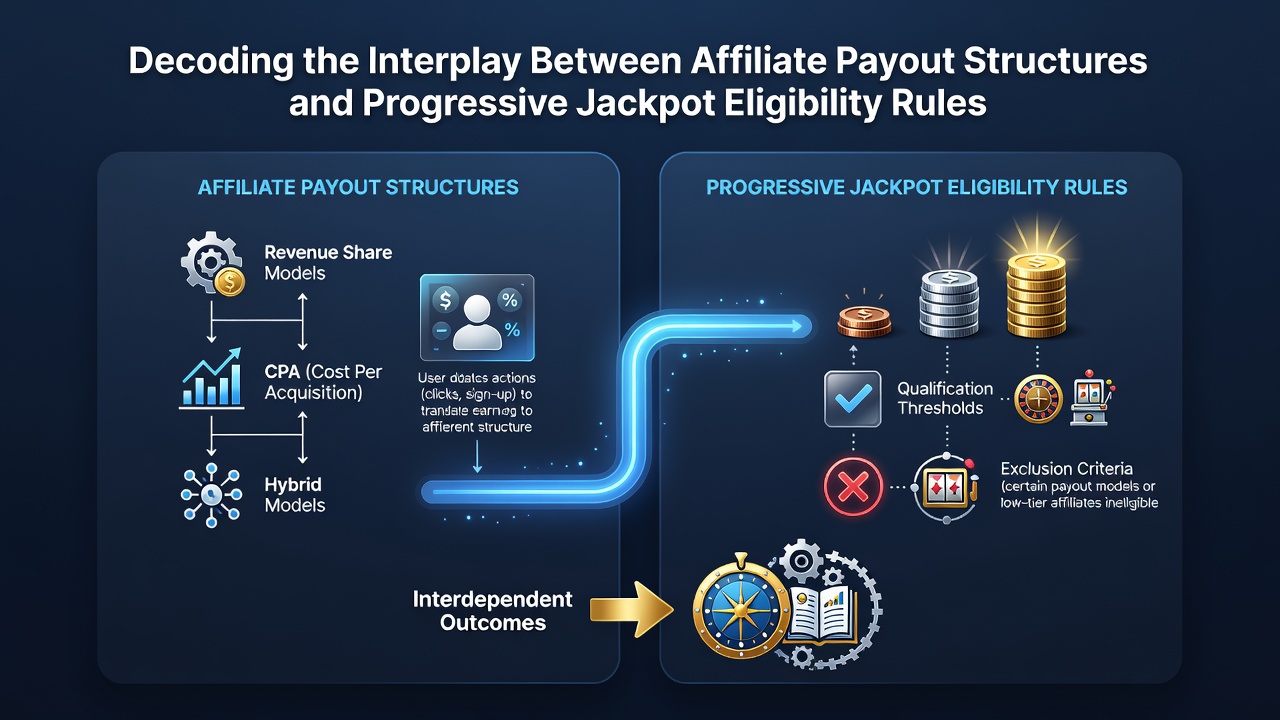
One documented case involved a mid-tier affiliate whose CPA-driven traffic triggered a 21-day cooldown before jackpot contributions activated, while revenue share referrals from the same network entered pools immediately. Such differentiation stems from contractual clauses that protect operators from high-volume, low-retention traffic patterns commonly associated with aggressive CPA promotions. Researchers at the University of Nevada Gaming Research Center have examined similar dynamics in other regulated markets and found that contribution windows tied to payout models affect overall jackpot growth rates by 12 to 18 percent depending on the proportion of CPA versus revenue share traffic.
Regulatory Context and Tracking Requirements
Licensed UK platforms must maintain audit trails that link every jackpot contribution to its originating affiliate tag, a requirement that becomes more complex when hybrid payout structures blend multiple compensation streams within a single player journey. Software providers such as Microgaming and NetEnt enforce their own contribution rules on top of operator policies, often mandating that only real-money wagers from verified deposits count toward progressive meters. Affiliates operating across multiple jurisdictions report that alignment between UK rules and those enforced by the Canadian Gaming Association creates additional compliance layers when campaigns target players eligible for both markets.
Conclusion
The relationship between affiliate payout structures and progressive jackpot eligibility continues to evolve as operators refine tracking mechanisms and regulatory updates scheduled for August 2026 introduce new data-sharing standards. Licensed platforms balance compensation incentives against pool security through differentiated rules that reflect the risk profiles of each affiliate model, while players encounter varying access conditions based on the traffic source that first directed them to the site. These mechanics remain central to how UK operators manage both affiliate partnerships and jackpot network participation.